Buying a home is something that people usually think about when they are a little older like in their twenties or early thirties. You save some money and you get a mortgage. Then you move in. It is supposed to be simple.. For a lot of younger Americans this idea of owning a home seems really far away especially now in 2026. On the other hand older Americans, especially the baby boomers are buying and selling homes really fast which is not what people thought would happen. The housing market is of dividing into two parts and it really depends on which generation you are part of the housing market is splitting into two and it has everything to do with which generation you belong to the younger Americans or the older Americans, like the baby boomers.
Who Is Buying Homes Right Now
According to the National Association of Realtors (NAR), baby boomers — people born between 1946 and 1964, now aged 61 to 79 — made up 42% of all home buyers from mid-2024 to mid-2025. That’s almost half the market. And on the selling side? They made up 55% of all sellers, too.
Millennials. People born between 1980 and 1998 now aged 27 to 45. Were the group of home buyers for a long time. The Millennials used to buy a lot of homes.. Now the share of Millennials who buy homes is going down. It went down from 29 percent to 26 percent, in one year. The Millennials are still buying homes. Not as many as they used to.
This does not seem like a difference but it shows something is happening: younger buyers are slowly being pushed out of the real estate market because the real estate market is simply too expensive, for many younger buyers.
Gen X buyers (aged 46 to 60) held steady at about 25%. Gen Z (aged 18 to 26) made up just 4% of buyers — a small number, though slightly up from last year.
Why Are Boomers So Dominant
Baby boomers bought their homes decades ago, when prices were much lower. Over the years, the value of those homes went up a lot. So now, when a boomer sells their home, they walk away with a large chunk of money — sometimes hundreds of thousands of dollars. They use that money to buy their next home, often without even needing a bank loan.
In fact, a growing number of boomer buyers are paying for homes entirely in cash. That gives them a huge advantage. When two people want to buy the same house, a seller almost always picks the cash buyer because there’s no bank involved, no waiting, no risk of the deal falling apart.
Boomers are buying homes for lifestyle reasons. A lot of Boomers are retiring now. They are downsizing to homes. Some Boomers are moving closer, to family and friends. Boomers are not buying homes because they have to buy one. Boomers are buying homes because they can buy one. And that freedom makes them very powerful in today’s market.
The Problem for First-Time Buyers
Here’s where things get really serious. The number of first-time home buyers has dropped to its lowest level ever recorded — just 21% of all buyers. NAR has been tracking this data since 1981, and it has never been this low.
Think about what that means. Back in the 1980s, about 40% of all home buyers were first-timers — people buying their very first house. Now it’s barely half that. And the average age of a first-time buyer has climbed to 40 years old. In 2010, that age was just 30.
This says a lot: it now takes people 10 more years to afford a first home compared to 15 years ago. That’s a change. It means someone spends a decade of their life renting instead of owning a home and building wealth.
Why is it so hard? A few reasons. Home prices have jumped dramatically — the median price of a home rose more than 50% between 2020 and 2024 alone. Mortgage rates also went up sharply after years of being very low. And there simply aren’t enough homes for sale. When supply is low and demand is high, prices rise even more, as rise in the inflation rates.
The Split Inside the Millennial Generation
Millennials aren’t all in the same boat, though. There’s a growing divide within the group itself.
Older millennials (ages 36 to 45) are actually doing well. They have the highest average household income of any group of buyers — about $132,700 per year. They’re buying the biggest homes (median size: 2,100 square feet) and are most likely to have kids at home. In many ways, they look more like the boomers they grew up resenting than like the struggling young buyers they used to be.
Why? Because many of them bought homes in the mid-2010s or during the early pandemic years, when prices were lower. Those homes went up in value. Now they’re using that equity — just like boomers have done for decades — to trade up to bigger, nicer homes. Only 33% of older millennial buyers were first-time buyers. Most already owned a home and were making a move to something better.
Younger millennials (ages 27 to 35), on the other hand, are still fighting to get in. They carry heavy student loan debt. They face high rents that make it hard to save. They’re competing in a market where boomers with cash and older millennials with equity are already ahead of them. For many, buying a home feels out of reach.
Younger millennials are really struggling to enter into the housing market,said NAR Deputy Chief Economist Jessica Lautz. “And that’s feeling out of reach for many of them.
A Mismatch: Big Homes, Empty Rooms
Here’s one of the strangest parts of the whole situation. According to a Redfin analysis, baby boomer empty nesters — that is, boomers whose kids have grown up and moved out — own 28% of all large homes (homes with three or more bedrooms) in the U.S. Millennial parents, who actually have kids at home and need the space, own just 16% of those large homes.
The people with all the space don’t need it. The people who need the space can’t afford it. This mismatch makes an already tight housing market even harder to deal with.
Many boomers stay in their big homes for a simple reason: they have little incentive to move. Some own their homes outright with no mortgage payment. Others locked in very low mortgage rates years ago and don’t want to give them up. Moving would mean buying at today’s higher prices, which doesn’t make financial sense for many of them.
What This Means Going Forward
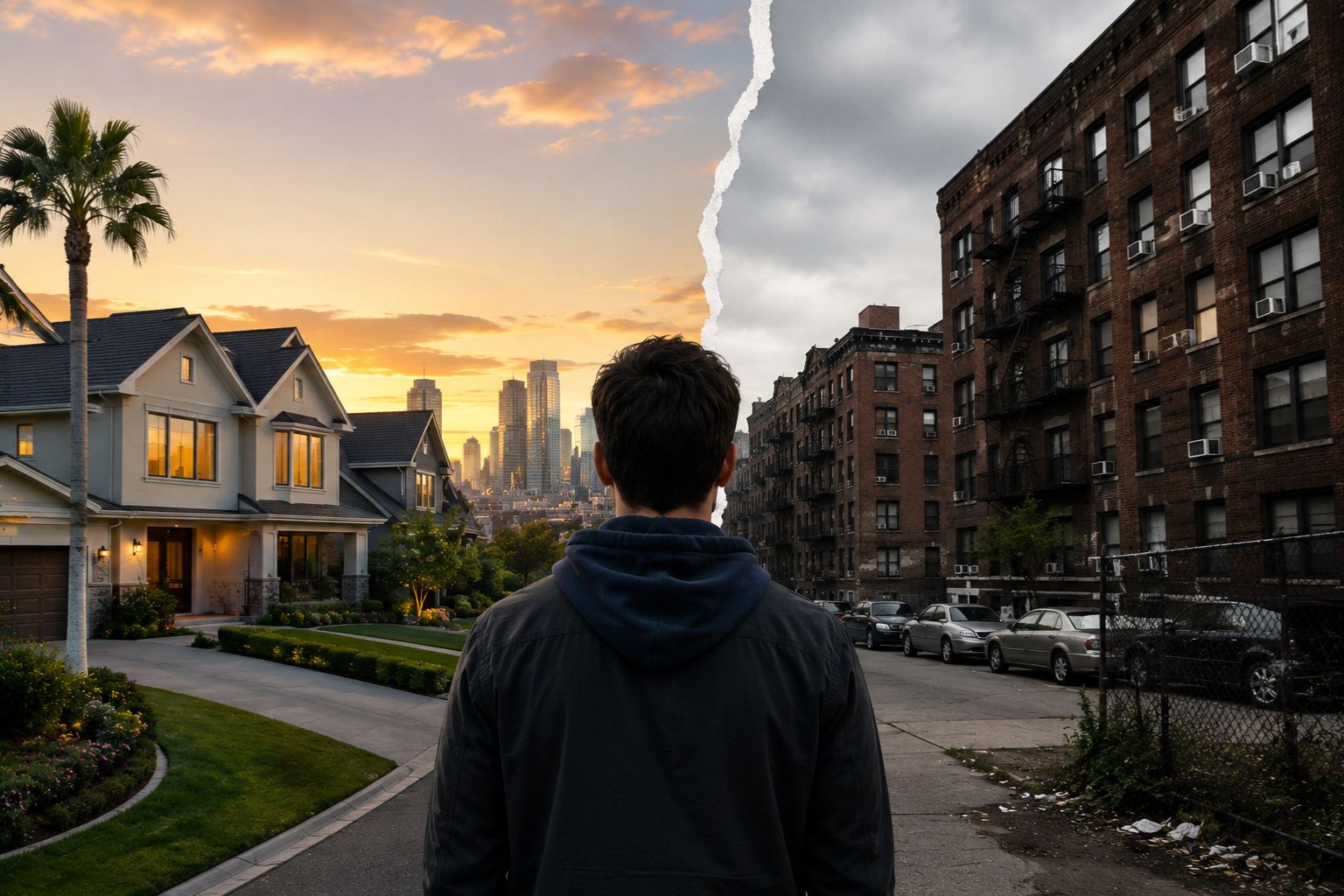
Experts call what’s happening a “K-shaped” housing market. Picture the letter K. The top line goes up — that’s people with home equity and high incomes who are doing well. The bottom line goes down — that’s people without equity who are getting left further behind. The two groups are moving in opposite directions.
The more time someone spends not owning a home the money they will not have. If someone is renting a house of owning a house they are not getting any money from that house. The difference between people who own homes and people who rent homes gets bigger and bigger over time. People who own homes like homeowners are getting money from their homes every year but people who rent homes are not getting any money, from the homes they rent. The longer someone is renting a home the money they will lose and the more money homeowners will have.
A first-time buyer who can’t get in until age 40 has 10 fewer years to build wealth compared to someone who bought at 30. As Lautz put it, It becomes a renter versus an owner economic scenario. And that’s really what we’re seeing right now.
There is some hope. Mortgage rates dipped slightly in early 2026, and more homes have started to come onto the market compared to last year. But experts agree that fixing this problem will take more than small changes — it will take a real increase in the number of homes available for people who are just starting out.