
Introduction
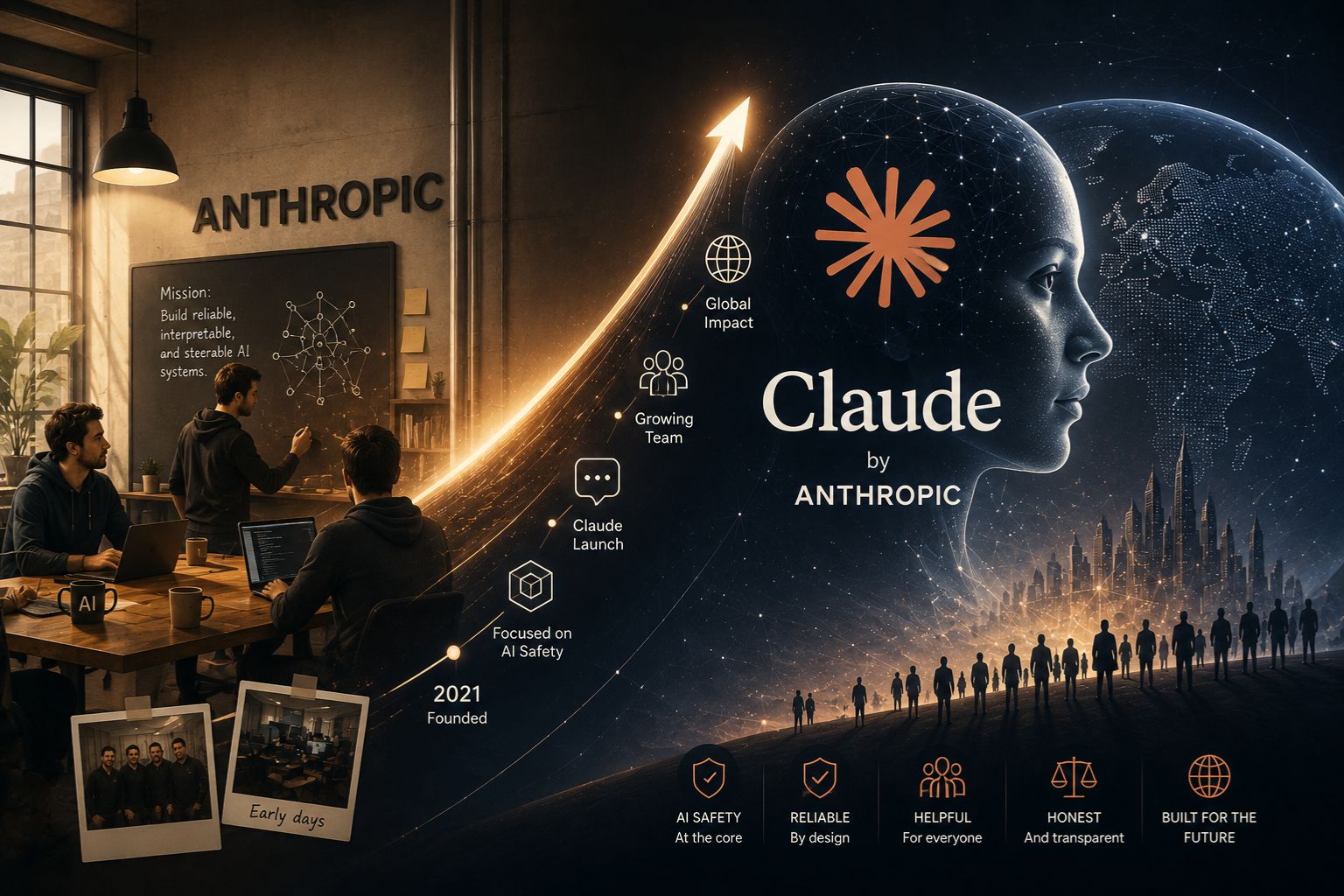
In 2021, a tiny team of researchers quit their renowned AI firm and founded an entirely new organization called Claude Anthropic.
They did not know back then that it would turn out to be the most valuable AI company in the world within five years. On May 28, 2026, it became one and even raised $65 billion in one funding round. As a result, it reached a value of $965 billion or close to $1 trillion.
It does not matter if you understand what artificial intelligence is. In this article, we explain everything using easy words.
What Exactly Is Claude Anthropic
Simply, you must consider Claude Anthropic is an AI research company started in 2021 by Dario Amodei,Daniela Amodei, and some of their colleagues and it is based in San Francisco. In reality they have worked at another famous AI laboratory, but they think of moving out and creating the new AI that is reliable and safe to use for the users.
Their goal was different from most tech companies. They did not just want to build smart AI. Their vision was to create a safe, truthful, and helpful AI. This concept of placing safety first is what makes them unique.
Their primary product is a line of AI assistants, referred to as Claude. Claude Anthropic has since evolved to become a suite of models, each tailored for specific use cases. Some are fast and lightweight. Others are more powerful and built for complex tasks.
Today, Claude Anthropic is used by thousands of companies around the world. From hospitals to banks to software teams, businesses are using it to do real work every day. That wide adoption is a big reason why investors started paying close attention.
How Did the Funding Grow So Fast?
The growth in funding has been remarkable.Within less than a year, the firm rose from an estimated $61.5 billion worth to almost $1 trillion worth. Let us now consider the progress made in each round.
Table 1: Overview of Funding Rounds
| Round | When | Valuation | Key Investors |
| Series E | Early 2025 | $61.5 Billion | ICONIQ, Lightspeed |
| Series F | Oct 2025 | $183 Billion | ICONIQ, Fidelity |
| Series G | Feb 2026 | $380 Billion | Multiple investors |
| Series H | May 2026 | $965 Billion | Altimeter, Sequoia |
Source: Anthropic official announcements and public reporting
Each round has seen an increase in both monetary value and prestige. It should be noted that the most significant increase was from $380 billion in February 2026 to $965 billion in May 2026. That nearly tripled the valuation in just three months.
The Series H round was led by Altimeter Capital, Dragoneer, Greenoaks, and Sequoia Capital. Other major names joined too — Blackstone, Fidelity, General Catalyst, Temasek, and more. Even Amazon put in $5 billion as part of a larger $15 billion commitment from big cloud companies.
This round has been accompanied by other strategic hardware providers like Micron, Samsung, and SK hynix. They are the suppliers of the semiconductor memories required for creating AI programs. Their involvement shows this is no longer just a software story. The whole supply chain is getting involved.
What Makes It Different From Other AI Companies?
There are a lot of AI companies right now. So what makes this one different? The answer comes down to two things — safety and enterprise trust.
How Claude Anthropic Thinks About Safety
Most AI companies talk about safety. Claude Anthropic has made it the core of everything they do. The company runs research into how AI models think, what they get wrong, and how to make them more reliable. This area of research is called interpretability — understanding what is happening inside an AI model.
This focus has won the trust of big businesses. Enterprise customers — the large companies that pay a lot of money for software — want AI they can trust. They need it to give accurate answers, handle sensitive information carefully, and not go off the rails. That is exactly what Claude AI is built to do.
The company has also published something called a model constitution — a set of values that guide how Claude behaves. This kind of transparency is rare in the AI industry, and it has helped build real confidence among users and regulators alike.
Why Businesses Choose Claude
Claude Anthropic is available on all three of the world’s biggest cloud platforms — Amazon Web Services, Google Cloud, and Microsoft Azure. That makes it easy for any business to access, no matter what tech setup they already have.
One product, in particular, drove massive growth in 2026. There was an AI coding assistant that gained popularity and increased usage by up to 84 percent among a large number of engineers from a particular ride-sharing company. Each engineer paid from $500 to $2,000 monthly. Usage rates were very high as the firm spent their entire yearly AI budgets in just four months.
The Numbers That Surprised Everyone
Let’s talk about the actual numbers. They are hard to ignore.
- Run-rate revenue crossed $47 billion in May 2026
- That is up from $10 billion in annual revenue in 2025
- In Q1 2026, quarterly revenue hit $4.8 billion
- Q2 2026 is expected to reach $10.9 billion — more than double
- The company signed compute deals worth up to 10 gigawatts in total
The compute deals deserve a closer look. The company signed agreements with Amazon for up to five gigawatts of new capacity. It also signed with Google and Broadcom for five gigawatts of next-generation chip capacity. And it got access to GPU clusters run by SpaceX, including two large computing facilities.
These are not small deals. Gigawatts of compute power cost billions of dollars. The fact that these agreements are in place tells you the company is planning for massive, continued growth.
The CFO of the company said in the official announcement that adoption has continued to grow across global enterprise customers. That phrase — global enterprise customers — matters. These are not small users. These are large corporations paying real money for reliable AI tools.
Claude Anthropic vs OpenAI — How the Tables Turned
OpenAI has always been considered the undisputed leader in artificial intelligence. It was responsible for launching the first popular chatbot which opened the discourse on AI back in late 2022, and it remained the frontrunner for many years. However, everything changed in May 2026.
Table 2: Side-by-Side Comparison (2026)
| Factor | Claude Anthropic | OpenAI |
| Valuation (2026) | $965 Billion | $852 Billion |
| Q1 2026 Revenue | $4.8 Billion | $5.7 Billion |
| Revenue Run Rate | $47 Billion | ~$25 Billion |
| Key Product | Claude / Claude Code | ChatGPT / API |
| Founded | 2021 | 2015 |
| IPO Plans | 2026 (expected) | 2026 (expected) |
| Safety Focus | Core mission | Growing focus |
Source: CNBC, Bloomberg, The Information, Anthropic official release (May 2026)
The valuation gap is now clear. The valuation of the AI safety firm stands at $965 billion, outperforming that of its competitor, whose last valuation stands at $852 billion as of March 2026.
But quarterly revenues point to a different trend. The quarter’s revenue stood at $5.7 billion for its competitor while only $4.8 billion for it. The rival still leads on quarterly revenue. But the annualised run-rate — a forward-looking number — tells a different story. The run-rate revenue of $47 billion is far ahead of the rival’s $25 billion annualised figure from earlier this year.
Both are predicted to go public within 2026. This implies that ordinary people will soon have access to their stocks. The race to go public is intense, and both parties are working hard towards their goal.
What This Means for Everyday People
You might be wondering — what does a $965 billion valuation have to do with me? More than you might think.
If you use AI tools at work, there is a good chance you are already touching products powered by this technology. More businesses are putting AI into their daily operations — writing, coding, customer support, legal review, healthcare, and more. As these tools improve and spread, the way we work changes.
This translates to two things for employees. Firstly, AI can handle repetitive tasks and allow them more time to do more meaningful things. Secondly, it means that knowing how to operate AI software will be an essential skill to learn.
For companies, the question is no longer about whether to adopt AI technology or not. The question is which AI to trust, and how to use it responsibly. The safety focus of this company has made it appealing to organisations that handle sensitive data — hospitals, law firms, and banks in particular.
There is also a broader economic question. When a company is worth nearly $1 trillion and is not yet publicly traded, a lot of that value sits with private investors. An IPO would change that, giving ordinary investors access. But it also brings more scrutiny — and that is probably a good thing for an industry that moves this fast.
What Comes Next?
On the same day as the funding announcement — May 28, 2026 — the company released a new model called Claude Opus 4.8. This is an upgrade to its more powerful model class, with stronger performance in coding, handling complex tasks, and long-running work.
There is also a model called Claude Mythos Preview. It is concerned about cybersecurity and is open only to certain firms. It appears that the firm is now considering adopting this for more specialized and secure applications.
On the global side, the company recently opened an office in Milan — its sixth in Europe. It also appointed a representative director in Korea ahead of a planned Seoul office. These clearly point to an intention of venturing beyond North America.
Partnerships with hardware providers like Micron, Samsung, and SK hynix must also be taken note of. Access to memory and chips is one of the major bottlenecks in AI development today. Having direct relationships with these manufacturers could give the company an advantage in scaling up quickly when demand spikes.
The IPO question remains open. This firm and its biggest competitor are expected to go public sometime in 2026. Sources close to the plan say that arrangements are being made. If it happens, it could be one of the biggest stock market debuts in years.
Conclusion
The story of how this company went from a 2021 idea to the world’s most valuable AI company is genuinely remarkable. It started with a focus on safety when the rest of the industry was focused on speed. That choice turned out to be exactly what the market wanted.
The $65 billion raise and the $965 billion valuation of Claude Anthropic are numbers that stop you in your tracks. Behind those numbers lie the true products, actual customers, and actual revenue growth like few other companies have achieved in history.
And here are the three most important lessons from this story:
- Trust wins — by fostering trust in enterprise customers, these companies built themselves a loyal customer base
- Fast and real revenue growth — from $10 billion in run rate to $47 billion in run rate within one year is truly outstanding
- There’s plenty left to be done in the artificial intelligence industry – valuations may fluctuate, competition adapts, but the new story has yet to unfold
This story, in particular, would be of interest to those who run businesses, enjoy listening to stories, or work in the area of artificial intelligence technologies. The decisions they make in the future will influence the way artificial intelligence technologies are used by people.